'The internet you grew up on isn't dying. A commercial veneer glued on top of it is.'

This is so, so, good:

“The places you spent your younger years are gone or unrecognizable, and the places you use now are visibly straining under a flood of machine-generated text nobody asked for. There is a low ambient grief about it, and a faint guilt, something like:

“I should be doing something. I should be somewhere else. I want the old thing back.”

I want to tell you a thing that I think is true, and that I think will make you feel better.

The internet is not dying.

A commercial veneer glued on top of it is dying.

The layer where every human activity became a venture-backed destination, every destination became a feed, every feed became ad inventory, and every ad market became a machine for producing more things to interrupt you with.

Underneath that layer is another internet: older, slower, less polished, harder to monetize, and much harder to kill.

It is not utopia. It is full of spam, abandoned servers, broken clients, hostile nodes, strange old commands, half-maintained software, and people arguing in plain text about things no normal person should care about.

But it has one enormous advantage over the platforms that replaced it in your imagination.

No one owns it.”

The Boring Internet, Terry Godier

The internet is being rebuilt for machines - Rebecca Bellan

“Cloud infrastructure has long been designed around humans who search, click, scroll, and stream in a steady and predictable fashion. AI agents behave differently. They can unleash a swell of activity, spinning up multiple sub-agents that query hundreds of databases, search documents, and call APIs in seconds and then disappear as quickly as they arrived.

Under that premise, Amazon is redesigning a core piece of its cloud infrastructure. On Thursday, AWS launched its next generation of OpenSearch Serverless, a fully managed search and vector database — essentially a system for storing and retrieving information at scale — that’s designed specifically for agentic workloads.”

The internet is being rebuilt for machines, Rebecca Bellan

AI is a political project: Karen Hao

A great interview with Karen Hao from Carole Cadwalladr.

This quote gave me horror chills:

" AI, as it is currently conceived by Silicon Valley, is a political project, and the central feature of this political project is to take agency away from people to ultimately make these entities, the empires, the monopolies on decision-making power in the world, if they can convince everyone that this is inevitable. “Don’t do anything about it,” you know, “just lie back and let it wash over you”. They have achieved their goal, which is to make sure that people don’t feel any ownership over their life, their data, their land, their resources, and their future any more."

‘It’s not progress, and we can stop it’: journalist Karen Hao on big tech, protest and the preventable AI future

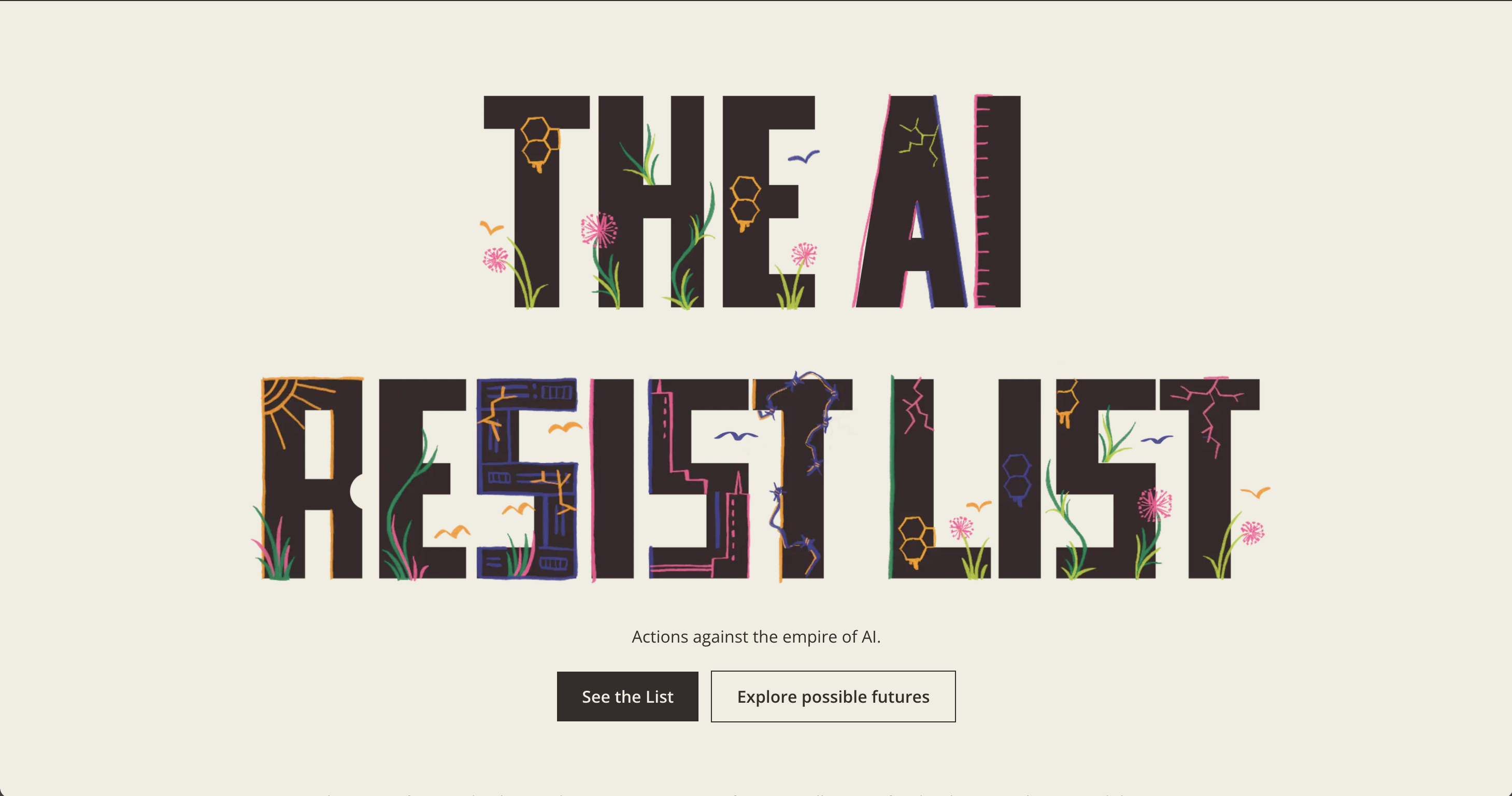
Karen Hao's AI Resist List

I was extremely excited to see this in my feed this morning from Karen Hao:

“On the one-year anniversary of EMPIRE OF AI, I am so, so excited to announce The AI Resist List, a new project that documents examples of resistance to the AI empires around the world: airesistlist.org.

Inspired by Choose Democracy’s Resist List against authoritarianism, the AI Resist List organizes resistance movements based on how they pressure different “Pillars of Support” that uphold and perpetuate the empires. Thus far it includes roughly 30 examples that span countries and contexts, highlighting a diversity of actions that range from the individual to institutional, from the artistic to the political. It also showcases eight examples of “Possible Futures,” projects already dreaming up and building alternatives to Silicon Valley’s extractive, corrosive vision of AI development.

The List underscores how the current trajectory of AI is not inevitable. Resistance is blossoming everywhere, and anyone can shape the future of AI development. Amid an onslaught of negative news, this project centers hope.”

The Pillars of Support is a really interesting concept. They are:

  1. Narrative
  2. Funding
  3. Data
  4. Data Centers
  5. Resource Extraction
  6. Labor
  7. Adoption
  8. Surveillance
  9. Policy

It’s also a lovely site to look at, with some beautiful illustrations.

The AI Resist List

Text in large letters spells out THE AI RESIST LIST with colorful and abstract designs inside the letters.

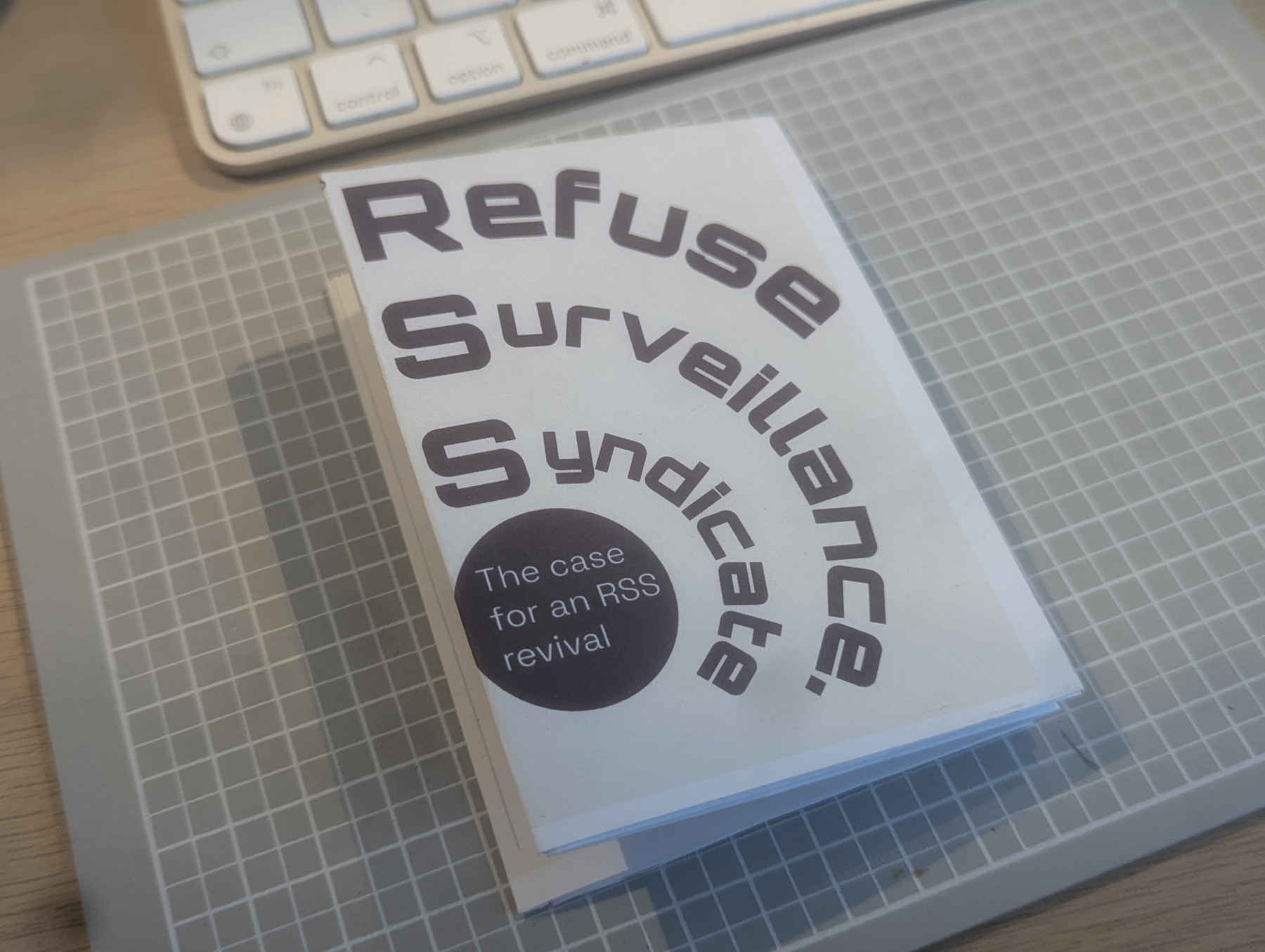
Refuse Surveillance. Syndicate

A booklet titled Refuse Surveillance Syndicate is resting on a cutting mat near a keyboard, advocating for an RSS revival.

I made a mini zine about why it’s time for an RSS revival (I know, I know, it never went away). Download it, print it, and then follow these instructions to fold it and cut it and make it ready to read.

Download the mini zine as a PDF

Alternatively, you can just read it here:

What is RSS?

An RSS feed is a file a website keeps updated with its latest content. An RSS reader collects those files, checking for new entries so you don’t have to. You probably already use something like this — open your podcast app. Every show you follow, every new episode, in chronological order. That’s RSS. Point a reader at any site with an RSS feed and it all lands in one place. Your own curated feed of content.

RSS: a brief history

RSS launched in 1999 and by the mid-2000s it was genuinely cool — a single place to follow everything you cared about on a busy, ever-expanding web. Then Facebook and Twitter came along. Publishers chased traffic to those platforms and built their audiences there instead. Why maintain a feed when the algorithm could do it for you? (RIP Google Reader, 2005–2013. The beginning of the end.)

The web got worse. RSS didn’t.

Social feeds promised to do what RSS did, but better. Then they enshittified — choked with ads, shaped by algorithms, optimised for engagement over everything else. RSS never did any of that. It just got on with it.

And it never went away. RSS is still here, quietly waiting for the hype cycle to turn. And it might be the best antidote to the enshittified web we’ve got. Because what RSS offers sounds pretty idyllic right now:

  • Control. You choose what’s in your feed. No platform decides for you.
  • Curation. No ads. No algorithm. Chronological order, always.
  • Anonymity. Read whatever you want. Nobody’s watching. No ad will follow you around after you’ve read something sensitive (or embarrassing).

Where to start

Getting started is simple. Find an RSS reader app, search for sites you want to follow, and subscribe to their feed. That’s it.

These are some popular options:

Try one, switch if it doesn’t feel right — your feeds are portable, so you’re never locked in. If a site you want to follow doesn’t have a feed, create one with a tool like fetchrss.com

Publish something? Give your readers a feed.

Your readers shouldn’t have to follow your work across platforms. A feed gives them one place to find you, on their terms — not the algorithm’s. If your site doesn’t have one, it’s straightforward to add. Most publishing platforms support it natively — including WordPress. It’s also worth knowing: AI agents are increasingly using RSS to find and read structured content. Even the robots want your feed.

Tracey Emin on AI

‘The problem with AI is it’s not about the arts or creativity or anything like that, it’s to do with truth. That’s the major problem for everybody in every possible field. We no longer know what truth is.’

Dark Forest Operating System: the new private internet

I heard about DFOS - Dark Forest Operating System - in an newsletter from Metalabel Studios. The readme doc says:

“DFOS is the infrastructure for new private internets. Where groupchats, members, money, and private feeds work together in one shared operatibg system.”

I’m not sure I 100% get it yet, but I’m interested.

DFOS

A computer desktop displays two icons, DFOS_README and Z0N, against a cloudy sky background with DARK FOREST OS noted above.

The Luddite Lab Resource Hub, a new resource for fighting AI at work

Last week I spoke about Spite House, the inevitability of AI, and the survival of the free web at Growing in Content conference. Quite a few of the questions I was asked were about how to resist AI when it’s being mandated at work. So I was excited when I saw this yesterday: the Luddite Lab Resource Hub, a new resource for fighting AI at work (especially as I spoke about the Luddites as part of my talk ❤️)

“The Luddite Lab Resource Hub is a place where workers, union leaders, researchers, and others can find resources to fight automation and AI at work. We do this by partnering with unions and other workers’ organizations who have fought–and won–workplace fights against technology which makes work worse.”

Luddite Lab Worker Resource Hub

There’s a launch event on 20th May if you’re interested

A stylized illustration of a person in a dynamic pose with a hammer is accompanied by text announcing the launch of the Luddite Lab Resource Hub on Wednesday, May 20, with registration details provided.