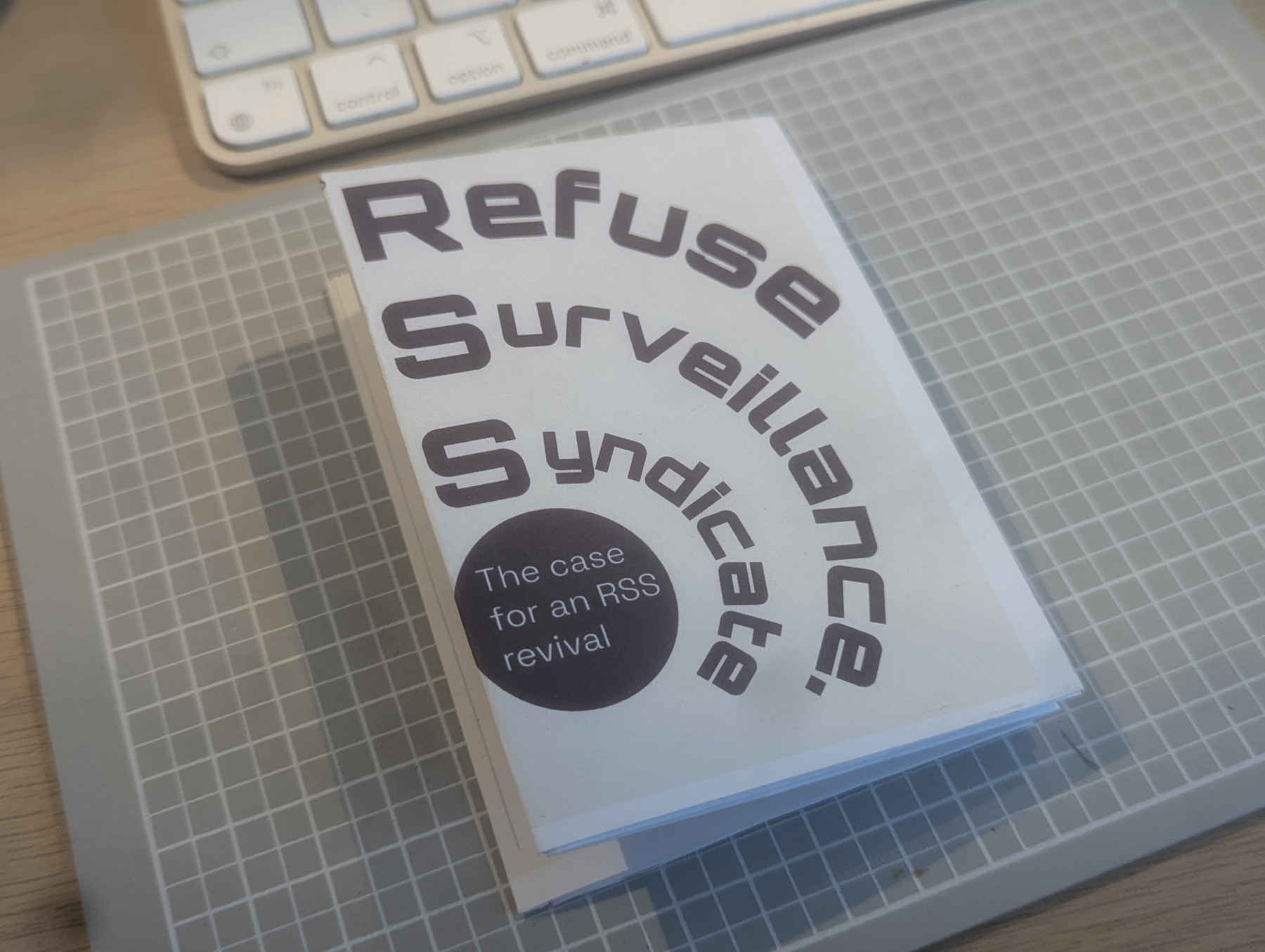
I made a mini zine about why it’s time for an RSS revival (I know, I know, it never went away). Download it, print it, and then follow these instructions to fold it and cut it and make it ready to read.
Download the mini zine as a PDF
Alternatively, you can just read it here:
What is RSS?
An RSS feed is a file a website keeps updated with its latest content. An RSS reader collects those files, checking for new entries so you don’t have to. You probably already use something like this — open your podcast app. Every show you follow, every new episode, in chronological order. That’s RSS. Point a reader at any site with an RSS feed and it all lands in one place. Your own curated feed of content.
RSS: a brief history
RSS launched in 1999 and by the mid-2000s it was genuinely cool — a single place to follow everything you cared about on a busy, ever-expanding web. Then Facebook and Twitter came along. Publishers chased traffic to those platforms and built their audiences there instead. Why maintain a feed when the algorithm could do it for you? (RIP Google Reader, 2005–2013. The beginning of the end.)
The web got worse. RSS didn’t.
Social feeds promised to do what RSS did, but better. Then they enshittified — choked with ads, shaped by algorithms, optimised for engagement over everything else. RSS never did any of that. It just got on with it.
And it never went away. RSS is still here, quietly waiting for the hype cycle to turn. And it might be the best antidote to the enshittified web we’ve got. Because what RSS offers sounds pretty idyllic right now:
- Control. You choose what’s in your feed. No platform decides for you.
- Curation. No ads. No algorithm. Chronological order, always.
- Anonymity. Read whatever you want. Nobody’s watching. No ad will follow you around after you’ve read something sensitive (or embarrassing).
Where to start
Getting started is simple. Find an RSS reader app, search for sites you want to follow, and subscribe to their feed. That’s it.
These are some popular options:
Try one, switch if it doesn’t feel right — your feeds are portable, so you’re never locked in. If a site you want to follow doesn’t have a feed, create one with a tool like fetchrss.com
Publish something? Give your readers a feed.
Your readers shouldn’t have to follow your work across platforms. A feed gives them one place to find you, on their terms — not the algorithm’s. If your site doesn’t have one, it’s straightforward to add. Most publishing platforms support it natively — including WordPress. It’s also worth knowing: AI agents are increasingly using RSS to find and read structured content. Even the robots want your feed.